
FAQ
Questions and Answers
We have collected answers to frequently asked questions related to the FULL ELECTRIC line-up.
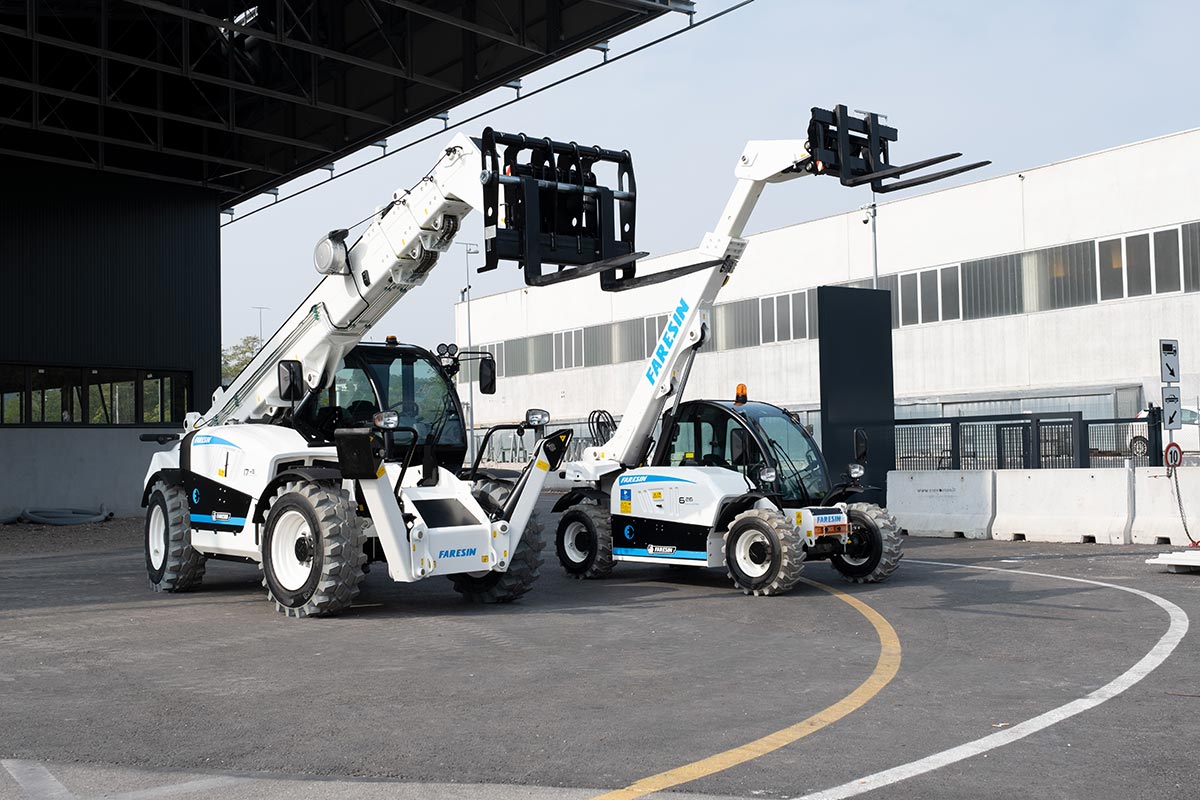
FULL ELECTRIC machines are 100% electric and are equipped with two electric motors: one for traction and one for arm movements.
- 6.26 FE: The machine is fully electric and can be equipped with a 330 Ah (25 kWh), 440 Ah (33.8 kWh), or 560 Ah (43 kWh) at 80 V to power two electric motors—one for the drivetrain with a rated power of 20 kW and one for the hydraulic systems with a rated power of 10 kW.
- Big Range FE: The machine is fully electric and features a 105 Ah (45.6 kWh) battery pack at 435 V to power two electric motors—one for the drivetrain with a rated power of 51 kW and one for the hydraulic systems with a rated power of 23 kW.
Depending on the battery capacity, the runtime under continuous intensive use can range from three to six hours, while under standard use it can range from six to eleven hours.
Many factors can affect range, including: the battery’s initial charge level, the environment, weather conditions, weight, accessories, rolling resistance, driving style, load, road conditions, and the use of features such as air conditioning. As a result, official range figures may vary further and differ from the data stated in the technical specifications.
-
- 6.26 The runtime in continuous intensive cycle mode in Eco mode can reach 3 hours with a 330 Ah battery, 4 hours with a 440 Ah battery, and approximately 6 hours with a 560 Ah battery.
- Big Range: The runtime in continuous heavy-duty mode in Eco mode is 3.5 hours with a 105 Ah (45.6 kWh) battery; in light-duty mode, it is 8 hours.
The machine is already optimized to minimize consumption, some adjustments can be made in the way the machine is used, which can limit battery use.
During the non-use phases of the machine, the power demand is suspended. If not used for more than 10 minutes, the telescope will turn itself off. It is advisable to keep the vehicle on charge during long periods of parking, with the standard charger (not Fast).
Energy recovery occurs under braking and when the accelerator is released and is automatically activated. Electric motors act as a generator by converting much of the machine’s kinetic energy into electricity, which is stored in the battery, increasing its range. So whether you are braking, or simply lifting the pedal off the accelerator, the battery can be partially recharged with this energy that would otherwise be lost. The regenerated energy becomes significant when traveling long downhill stretches.
The 6.26 Full Electric telescopic handler with a standard cycle consumes an average of 6.4 kWh of energy; the same model equipped with a diesel engine consumes 3.5 L/h of fuel, which corresponds to approximately 15 kWh of energy, under the same operating cycle.
In terms of energy consumption, therefore, the Full Electric model is much more efficient.
The endothermic engine has been replaced by two electric motors, one for traction and one for services, powered by a lithium-ion battery pack located in the engine compartment.
- For the 6.26 Full Electric, the differences compared to the diesel model are:
The internal combustion engine has been replaced by two electric motors—one for propulsion and one for auxiliary power—powered by an 80-volt lithium-ion battery pack located in the engine compartment.
The 20-kW electric traction motor has been mounted on the front axle.
The 10-kW electric motor that drives the hydraulic pump has been mounted on the rear axle. - For the Big Range Full Electric, the differences compared to the diesel model are:
The internal combustion engine has been replaced by a lithium-ion battery pack.
An electric traction motor (51 kW drive motor) has been mounted on the front axle.
Another electric motor has been installed to drive the hydraulic pump (23 kW hydraulic service motor).
The battery is designed in such a way as to make the need to replace it entirely highly unlikely. In the circumstance that a battery repair needs to be carried out, the replacement should be done by trained and authorized personnel.
- The life cycle of the battery depends on the way it is handled and the conditions under which it is used.
- The operator can help preserve battery life by choosing traditional charging over fast charging. When using fast recharges, charging the battery to 80% instead of 100% can help protect its lifespan.
From -10° to +40°
0° to +40° by always leaving the machine plugged in with the standard standard charger, checking its condition at least every two months.
- Regarding FR00E, it is not possible, they are not compatible by voltage and connector.
- As for FR04E, it is possible to recharge the vehicle at public charging stations
- FR00E
Speed with 16.5” wheels (standard) 0–12 km/h
Speed with 18” wheels (optional) 0–15 km/h - FR04E
First-gear speed: 10 km/h
Second-gear speed: 25 km/h
Advantages over a diesel: I don’t have to get it serviced or change fuel filters.
Maintenance on the hydrostatic drive is much more limited; the motor is directly connected to the axle.
Unlike a diesel, neither the battery nor the motors require maintenance.
Get in touch with us
Do you still have questions? You can contact us, at no cost, every day from 8 a.m. to 6 p.m. via call to our International Customer Care service.
